
Nitrogen Generator
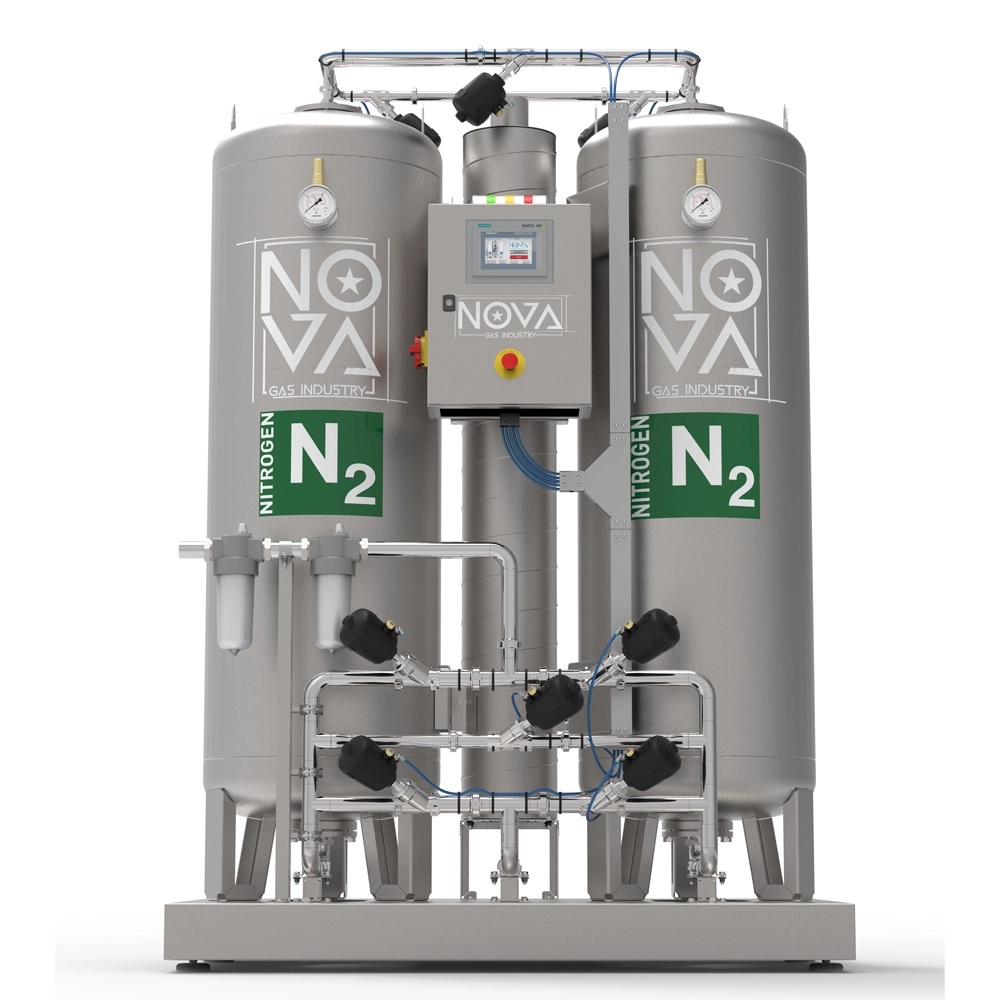
What Is a Nitrogen Generator?
A nitrogen generator is an industrial gas production system that produces high-purity nitrogen by separating it from oxygen and other components present in atmospheric air.
In systems utilizing PSA (Pressure Swing Adsorption) technology, in particular, compressed air is passed through specialized adsorbent materials, which separate the oxygen to yield nitrogen.
The nitrogen produced can be stored in tanks and utilized according to the requirements of the production line.
Reliable and Uninterrupted Nitrogen Production for Industrial Facilities
Nitrogen gas, used in industrial production processes, is critical in terms of high purity, continuous supply, and process safety. While nitrogen requirements were traditionally met through gas cylinders or liquid nitrogen systems, businesses can now meet these needs more efficiently and with greater control by using PSA nitrogen generators, which allow them to produce nitrogen on-site.
Nova Gas Industry develops PSA-based nitrogen generator systems tailored to the needs of various sectors, providing comprehensive nitrogen production solutions for industrial facilities. The primary objective of the system is to separate nitrogen from other gases present in the ambient air, producing nitrogen gas at the required purity level and flow rate.
Nova Gas Industry Nitrogen Generator
Nova Gas Industry designs and manufactures nitrogen generator systems tailored to the specific capacity and purity requirements of various businesses.
The capacity of a nitrogen generator system is determined based on a business’s hourly nitrogen consumption, required nitrogen purity, operating pressure, and intended application.
Consequently, a generator of the same capacity may not be suitable for every business. Selecting the correct capacity is of great importance for the efficient and economical operation of the system.
What You Need to Know Before Investing in a Nitrogen Generation System
For industrial enterprises, gas supply is a critical factor that directly impacts production continuity. Relying on external supply—especially for facilities with consistent and high nitrogen gas consumption—can lead to cost volatility and operational risks. Consequently, investing in a nitrogen generation system becomes a strategic decision for many businesses.
An on-site production model using a nitrogen generator allows companies to produce their own gas. When analyzed correctly, this approach offers significant advantages in terms of cost control, supply security, production planning, and consistent quality.
You can explore the following topics in detail:
How to evaluate an investment in a nitrogen generation system
Which data points are essential when selecting the capacity of a nitrogen generator
How the requirement for high-purity nitrogen gas influences investment decisions
The correct planning steps for nitrogen generators used in laser cutting applications
Why Should an Investment Decision Begin with Consumption Analysis?
The first step before purchasing a nitrogen generation system is to conduct a thorough analysis of actual consumption. It is difficult to select the appropriate capacity without clearly determining a facility’s hourly, daily, and monthly nitrogen gas requirements. If this analysis is not performed, the system may either prove insufficient or result in unnecessarily high investment costs due to excess capacity.
Consumption analysis should encompass not only current usage but also future growth plans. Factors such as investments in new machinery, an increase in the number of shifts, or the diversification of product lines can directly affect gas requirements.
Data to be examined in consumption analysis:
- Daily nitrogen gas consumption
- Maximum hourly consumption
- Number of shifts
- Peak consumption periods
- Number of machines in use
- Types of materials
- Current gas supply costs
- Future capacity expansion plans
Collecting this data allows for a more realistic investment calculation. An accurate consumption analysis is the foundation of any investment in a nitrogen generator.
How Is Nitrogen Generator Capacity Determined?
When determining the capacity of a nitrogen generator, looking solely at the average consumption value is insufficient. The flow rate required during the production line’s peak operational periods is critical data for determining system capacity. Furthermore, as the required purity level of the nitrogen gas increases, the flow rate that a given system can produce may change.
Therefore, purity, pressure, and flow rate must be evaluated together when calculating capacity. This calculation becomes even more significant in applications that demand high pressure and involve variable consumption, such as laser cutting.
Factors to consider when determining capacity:
- Required gas flow rate
- Purity level
- Operating pressure
- Type of application
- Compressor capacity
- Tank volume
- Consumption fluctuations
- Need for backup/redundancy
Accurately determining capacity directly impacts the long-term efficiency of the system. A system that is too small may disrupt production, while a system that is unnecessarily large may extend the return on investment (ROI) period.
How Does the Requirement for High-Purity Nitrogen Gas Affect Investment Costs?
The requirement for high-purity nitrogen gas is one of the most critical parameters in the design of a nitrogen generation system. While higher purity levels may be mandatory for certain applications, not every production process requires the highest possible purity. Therefore, accurately determining the necessary purity level plays a crucial role in terms of investment costs.
Aiming for a purity level higher than necessary can impact system capacity and energy consumption. Conversely, opting for a lower purity level may negatively affect production quality. The optimal solution is to determine the precise quality standard required by the specific process.
Questions to consider when deciding on purity levels:
- How critical is oxidation in the production process?
- How is the product surface evaluated by the customer?
- Are any additional processes performed after laser cutting?
- Are there requirements specific to sensitive sectors, such as food or electronics?
- Will gas purity be measured on a regular basis?
- How does a change in purity affect production quality?
Addressing these questions ensures that the investment is made within the correct technical framework. The target for nitrogen gas purity must strike a balance between quality requirements and costs.
Specific Criteria for Nitrogen Generator Investments in Laser Cutting
For laser cutting operations, selecting a nitrogen generator requires a more detailed approach than standard gas consumption calculations. This is because consumption in laser cutting varies based on factors such as material thickness, nozzle diameter, cutting pressure, laser power, and production speed. Therefore, machine specifications must be thoroughly analyzed when investing in a nitrogen generator for laser cutting.
Furthermore, expectations regarding cutting quality also influence system design. For operations that require oxidation-free, bright, and clean-cut edges, the need for high-purity nitrogen gas becomes even more pronounced. Key considerations for investing in a nitrogen generator for laser cutting:
- Make and model of the laser machine
- Types of materials being cut
- Range of material thicknesses
- Nozzle diameters
- Cutting pressure values
- Daily production volume
- Existing compressor infrastructure
- Plans for integration with an air-assisted laser cutting system
When analyzed correctly, the system can be designed to be fully compatible with the laser cutting line. This allows the operation to better manage both gas costs and cutting quality.


How Is the Total Cost of Ownership Calculated?
When investing in a nitrogen generation system, looking solely at the purchase price can be misleading. The total cost of ownership encompasses factors such as energy consumption, maintenance expenses, spare parts, service support, equipment lifespan, and production efficiency. This approach leads to more sound investment decisions.
When comparing the model of on-site generation against external gas supply, one must also account for monthly consumption, unit gas costs, logistics expenses, and inventory management. This provides a clearer picture of the payback period for a nitrogen generator investment.
Key factors to consider in the total cost calculation include:
- Initial investment cost
- Energy consumption
- Maintenance and service costs
- Expenses for filters and consumables
- Compressor operating costs
- Comparison of gas supply costs
- Risk of production downtime
- System lifespan and resale value
This ensures that a business’s investment decisions are based on data rather than intuition. When calculated accurately, an investment in a nitrogen generator is not merely a cost—it is an investment in production security.
Nova Gas Industry’s nitrogen generator systems offer a robust technological alternative for laser-cutting businesses, enabling them to meet their gas requirements through their own on-site production infrastructure.
Configured with the appropriate capacity, purity, and pressure levels for specific applications, these systems allow for the controlled production of the nitrogen required for cutting operations. In this way, businesses can reduce their reliance on external gas supplies while gaining greater flexibility in their production planning.
More Than Just a Generator: An Integrated Nitrogen Gas Production System
In Nova Gas Industry’s approach to industrial nitrogen production, the seamless integration and compatibility of system components are of paramount importance.
The compressed air infrastructure, drying and filtration equipment, gas storage tanks, and automated control systems used in nitrogen production form the core elements of an integrated manufacturing process.
In nitrogen generators utilizing PSA (Pressure Swing Adsorption) technology, atmospheric air is separated with the aid of specialized adsorbent materials to produce nitrogen.
Proper system design ensures that gas purity, production capacity, and operating pressure are precisely tailored to the specific requirements of the application.
Meanwhile, modern control technologies facilitate the monitoring of operational parameters and the management of the production process.
This technological infrastructure offers a significant advantage, particularly for industrial facilities that require a continuous supply of nitrogen.
200 BAR PSA NITROGEN GENERATOR SYSTEM DIAGRAM

40 BAR PSA NITROGEN GENERATOR SYSTEM DIAGRAM


Nitrogen Generator or Nitrogen Cylinder?
Which Solution Is More Advantageous for Your Business?
In industrial facilities, production lines, and various industrial applications, nitrogen gas is widely used to prevent oxidation, maintain product quality, and enhance process safety. While nitrogen cylinders have long been the traditional method for supplying nitrogen, many businesses today are opting for nitrogen generator systems to produce their own nitrogen on-site.
So, which is the better choice for your business: a nitrogen generator or nitrogen cylinders? The answer depends on several factors, including the volume of nitrogen consumed, the duration of use, purity requirements, operational capacity, and long-term costs.
What Is a Nitrogen Cylinder?
Nitrogen cylinders involve the delivery of pre-produced nitrogen gas, stored under high pressure, to a facility. This can be a practical solution, particularly for businesses with low or irregular nitrogen consumption.
However, for businesses that require a continuous supply of nitrogen, using cylinders presents certain operational challenges. It necessitates regular ordering, transportation, and storage of cylinders, as well as the replacement of empty ones. As consumption increases, logistics processes and gas supply costs can become a significant expense for the business.
What Is a Nitrogen Generator?
A nitrogen generator is a system that allows a business to produce its own nitrogen gas by separating nitrogen from other gases present in the air. In this way, businesses can produce the nitrogen they require on-site, rather than relying on a continuous external supply of nitrogen cylinders or similar gas containers.
Nitrogen generators offer significant advantages, particularly for businesses that require a constant and high-volume supply of nitrogen. Both the system capacity and the nitrogen purity level can be tailored to the specific process requirements of the business.
Differences Between a Nitrogen Generator and Nitrogen Cylinders
The primary difference between a nitrogen generator and nitrogen cylinders lies in the method of supply. With a cylinder-based system, a business purchases ready-to-use nitrogen from an external source, whereas with a generator system, the nitrogen is produced within the business’s own facility.
Key advantages of a nitrogen generator:
- Ability to produce nitrogen continuously
- Reduced need for purchasing and replacing gas cylinders
- Minimized gas transportation and logistics requirements
- Capacity selection tailored to the business’s specific needs
- Flexibility to achieve various nitrogen purity levels as required
- More controlled long-term gas supply costs
- Greater supply continuity for production processes
A nitrogen generator is an excellent option for operations that require a constant supply of nitrogen—particularly in fields such as laser cutting, food packaging, electronics, chemicals, metal processing, heat treatment, and various other industrial manufacturing applications.
Which Businesses Should Choose a Nitrogen Generator?
For businesses with low nitrogen consumption or those that use nitrogen only occasionally, relying on gas cylinders may remain a practical solution. However, if nitrogen is used regularly in the production process, daily consumption is high, or a consistent gas supply is critical to operations, a nitrogen generator may be a more suitable alternative.
When selecting the right generator, it is essential to consider not only the volume of nitrogen consumed but also technical criteria such as required nitrogen purity, flow rate, operating pressure, duration of use, and compressor capacity.
Nitrogen Production Tailored to Your Needs with Nova Gas Industry
Every business has unique nitrogen requirements. Therefore, selecting a nitrogen generator should not be a matter of choosing a “standard” off-the-shelf product; rather, it should be based on a careful assessment of the business’s actual consumption levels and specific process requirements. Nova Gas Industry provides nitrogen generator solutions for industrial applications, assisting businesses in identifying the systems best suited to their specific needs. By evaluating your nitrogen consumption, required purity levels, and operational conditions, you can determine the ideal nitrogen generator solution for your requirements.
For businesses with low or intermittent nitrogen usage, gas cylinders may be a practical choice. However, for operations that require a continuous supply of nitrogen and are seeking a long-term, controlled gas delivery system, a nitrogen generator stands out as a significant alternative.
How Does a PSA Nitrogen Generator Work?
PSA stands for **Pressure Swing Adsorption**. This technology is based on the principle of separating nitrogen from air by adsorbing oxygen and other components through pressure fluctuations.
In a PSA nitrogen generator system, the process begins with an **air compressor**. The compressor draws in atmospheric air, compresses it, and feeds it into the system. The compressed air is then stabilized in an **air receiver tank** before being delivered to the downstream equipment in a controlled manner.
To remove unwanted components—such as particulates, oil aerosols, and moisture—the compressed air undergoes filtration and drying stages. Equipment such as **pre-filters, air dryers, and after-filters** are used here to ensure that the compressed air entering the PSA towers is as clean and dry as possible.
Nitrogen Separation in PSA Towers
The core of the system is the PSA unit, which consists of two adsorption towers. As shown in the diagram, **Adsorption Tower A and Adsorption Tower B** operate alternately.
Inside these towers is an adsorbent material, typically in the form of a molecular sieve. When compressed air enters a tower, the adsorbent captures oxygen and certain other components, while nitrogen gas passes through the system and is separated as the product gas.
Because the two towers operate in an alternating cycle, one tower produces nitrogen while the other undergoes a regeneration phase. They then swap roles. This operating principle forms the basis for continuous nitrogen production.
The pneumatic valve assembly within the system ensures that the airflow is directed to the appropriate tower and automatically manages the production and regeneration cycles of the towers. The control panel, meanwhile, facilitates the monitoring and control of the system’s operating parameters.
Where Is the Produced Nitrogen Stored?
Nitrogen exiting the PSA towers can be directed to a nitrogen tank (buffer/receiver tank), depending on requirements. This tank helps maintain a balance between pressure and flow rate within the system and at the point of consumption.
An outlet filter may also be incorporated into the system to ensure that the nitrogen gas maintains the required quality standards before reaching the point of use. Subsequently, the nitrogen is routed to the production line or directly to the process equipment.
Waste gas generated during the system’s regeneration phase is vented out in a controlled manner. If necessary, an exhaust silencer can be used to reduce the noise level produced during regeneration. Advantages of PSA Nitrogen Generators
On-site nitrogen generation in industrial facilities offers numerous benefits to businesses:
- Uninterrupted nitrogen supply: Nitrogen can be produced in-house, exactly when and where it is needed.
- Alternative to cylinder logistics: Eliminates the need for constant cylinder replacement, transportation, and storage.
- Capacity tailored to requirements: Flow rate, purity, and operating pressure can be configured to meet specific process needs.
- Automated operation: The production cycle can be managed automatically via a control system.
- Greater operational control: Nitrogen production and consumption can be monitored and managed entirely within the facility.
- Long-term durability: With proper maintenance and correct operating conditions, these systems are designed for long-term use.
- Optimized space utilization: Compressors, tanks, filters, dryers, and PSA towers can be integrated into a single, cohesive system design.

How to Perform Nitrogen Generator Maintenance?
Critical Control Points for Uninterrupted Production
In industrial production, a nitrogen generator should not be evaluated solely based on its performance on the day of installation. At Nova Gas Industry, we believe that the true value of a system lies in its ability to maintain consistent levels of purity, capacity, and reliability over long periods of operation. For this reason, periodic maintenance is an integral part of the investment.
The purpose of maintenance is not merely to replace a component after a breakdown occurs. Regularly checking filters, valves, sensors, pressure levels, and air preparation equipment helps in identifying potential issues at an early stage.
What Should Daily Checks Include?
Simple checks performed by operators are highly valuable for monitoring the system’s operational status. Data regarding pressure, purity, and alarms displayed on the control screen should be monitored regularly.
We recommend that daily checks be brief yet systematic.
Key parameters to monitor include:
- Product nitrogen purity
- Outlet pressure
- Inlet air pressure
- Alarms and warnings
- Dew point
- Any unusual sounds or vibrations
Being familiar with normal operating values makes it easier to detect any abnormalities early on.
Why Is Filter Maintenance Critical?
Filters prevent contaminants present in the compressed air from reaching the PSA (Pressure Swing Adsorption) system. Over time, filter elements can become clogged, leading to increased pressure drops and a decline in air quality.
We consider filter maintenance essential for protecting the CMS (Carbon Molecular Sieve) and ensuring continued energy efficiency.
Filter maintenance:
- The pressure differential should be checked.
- Filter elements should be replaced at the recommended intervals.
- Condensate drains should be inspected.
- Gaskets and connections should be examined.
- Filter housings should be checked for leaks.
While delaying filter replacement might seem like a minor saving on maintenance costs, it can lead to much higher overall system costs.
How Are Pneumatic Valves Checked?
In a PSA (Pressure Swing Adsorption) cycle, valves manage the pressurization, gas transfer, and regeneration phases between the towers. Consequently, any issues with valve timing or sealing can negatively impact both purity and capacity.
We consider valve inspections to be an integral part of a periodic maintenance plan, rather than something to be addressed only when a mechanical failure occurs.
Inspection points:
- Opening and closing times
- Air leaks
- Sealing integrity
- Actuator performance
- Connection hoses
- Control signals
These checks help ensure the stability of the cycle.
Purity Sensors and Measurement Systems
Nitrogen purity is one of the most critical indicators of system performance. If a sensor provides an inaccurate reading, an operator might reach an incorrect conclusion about the system’s status, even if the system itself is functioning properly.
We emphasize the importance of inspecting measurement equipment in accordance with the manufacturer’s recommendations and performing calibration whenever necessary. In measurement systems:
- Sensor values should be compared.
- Calibration status should be checked.
- The sample line must be kept clean.
- Gas flow must be correct.
- Alarm limits should be reviewed.
Accurate process control is not possible without accurate measurement.
How Is CMS Performance Monitored?
It may not be possible to directly observe the health of a Carbon Molecular Sieve (CMS) on a daily basis. However, changes in purity, flow rate, and air consumption can provide information regarding the performance of the adsorbent.
Before deciding to replace the CMS (Carbon Molecular Sieve), we believe it is essential to evaluate the entire system. A drop in purity could also be caused by issues with filters, valves, or the quality of the air supply.
Indicators to look for include:
- Difficulty in reaching target purity levels
- A decrease in product flow rate
- Increased air consumption
- Changes in tower pressure behavior
- Deterioration in the quality of the inlet air
These data points can assist in a technical service assessment.
How Does Periodic Maintenance Reduce Unplanned Downtime?
In industrial facilities, unplanned downtime does more than just incur maintenance costs; it can lead to additional expenses due to production losses, delivery delays, and the complexities of restarting operations.
We believe that aligning maintenance planning with the production schedule is the most effective approach. Monitoring the condition of critical components in advance allows maintenance to be performed at the optimal time.
Benefits of planned maintenance:
- Early detection of potential failures
- Effective spare parts planning
- Control over maintenance duration
- Reduction in production interruptions
- Extended equipment lifespan
Maintenance costs should be viewed as an investment that preserves the operational lifespan of the system.
Why Are Technical Service and Spare Parts Important?
An Nitrogen Generator is an industrial system designed for long-term use. Therefore, access to technical service and the continued availability of spare parts should be key considerations during the procurement phase.
At Nova Gas Industry, we view after-sales technical support as an integral part of the investment’s entire lifecycle. Using the right part at the right time contributes to maintaining the system’s design performance.
Within the service plan:
- Critical spare parts must be identified.
- Maintenance history must be kept on record.
- User training must be updated.
- Alarm history must be evaluated.
- Operating parameters must be compared.
This approach ensures that maintenance is carried out in a more planned manner.
10 Critical Factors to Consider When Choosing a Nitrogen Generator
In industrial production processes, nitrogen gas plays a vital role across various sectors, including laser cutting, metal processing, food packaging, chemicals, electronics, and automotive. Selecting the right nitrogen generator is essential for businesses to obtain the nitrogen they need for their production processes in a reliable, cost-effective, and sustainable manner.
Developed as an alternative to traditional methods—such as sourcing nitrogen via cylinders or in liquid form—industrial nitrogen generators allow businesses to produce the nitrogen they require on-site. This reduces reliance on external suppliers, streamlines logistics, and helps optimize long-term operational costs.
However, not every nitrogen generator is suitable for every production facility. Technical criteria such as nitrogen purity, production capacity, energy consumption, operating pressure, and maintenance requirements all play a decisive role in the selection process.
With its solutions for industrial nitrogen generation, Nova Gas Industry aims to help businesses identify the systems best suited to their specific production needs. So, what criteria should be considered when purchasing a nitrogen generator?
- Nitrogen Purity Level
One of the most important factors to evaluate when choosing a nitrogen generator is the purity level of the nitrogen gas produced.
Different industrial applications require different levels of nitrogen purity. For instance, laser cutting processes may demand high-purity nitrogen, depending on the type of material, its thickness, and the desired quality of the cut. In food packaging, the specific characteristics of the product and relevant quality standards are the determining factors. Depending on the system design and operating conditions, a nitrogen generator utilizing PSA technology can achieve nitrogen purity levels of up to 99.999%.
Opting for a system with a purity level higher than necessary can increase both energy consumption and investment costs. Therefore, when selecting a nitrogen generator, it is essential to determine the specific purity level actually required by the production process.
- Production Capacity of the Nitrogen Generator
Another important criterion is the amount of nitrogen the generator can produce per unit of time.
The capacity of a nitrogen generator is typically expressed in Nm³/h (normal cubic meters per hour). The appropriate system should be selected by taking into account the facility’s hourly nitrogen consumption, production intensity, and potential future capacity increases.
When determining capacity, the following questions should be considered:
- What is the hourly nitrogen requirement of the production line?
- Is nitrogen consumption continuous or intermittent?
- How many machines use nitrogen simultaneously?
- Are there plans to increase production capacity in the future?
A nitrogen generator with a capacity lower than what is required can negatively affect production continuity. Conversely, a system that is larger than necessary may lead to higher initial investment costs.
Therefore, an accurate capacity calculation forms the foundation of an efficient nitrogen production system.
- PSA Nitrogen Generator Technology
One of the technologies commonly used in industrial nitrogen production is the PSA (Pressure Swing Adsorption) system.
PSA nitrogen generators operate on the principle of separating oxygen from compressed air using a carbon molecular sieve (CMS) material.
This technology enables businesses to produce the nitrogen they require on-site.
Key features of PSA nitrogen generators include automatic operation, a range of capacity options, the production of high-purity nitrogen, and the ability to reduce the need for external nitrogen supply.
However, the performance of a PSA system depends on; …depends on the quality of the adsorbent material used, the air conditioning equipment, the operating pressure, and the engineering design of the system.
- Energy Consumption and Operating Costs
When purchasing a nitrogen generator, it is not advisable to focus solely on the initial investment cost.
The long-term operating costs of the system must also be evaluated. In particular, the electricity consumption of the compressors used to generate compressed air has a significant impact on the total cost.
When assessing energy efficiency, the electrical energy consumed per unit of nitrogen produced should be taken into account.
A properly designed nitrogen generation system can help reduce unnecessary energy consumption.
When evaluating nitrogen generator solutions from Nova Gas Industry, considering the system’s capacity, purity, and energy requirements together contributes to more economical investment planning from an operational perspective.
- Operating Pressure and Application Requirements
Not every industrial application requires the same nitrogen pressure.
In particular, fiber laser cutting machines may require nitrogen gas to be used at specific pressure levels. These values vary depending on the material being cut, its thickness, and the technical specifications of the laser cutting machine.
The outlet pressure of the nitrogen generator may differ from the operating pressure required by the production line.
For this reason, pressure regulation, nitrogen storage tanks, and—if necessary—nitrogen pressure-boosting equipment should be considered collectively during system design.
Providing a stable supply of nitrogen at the appropriate pressure helps maintain production quality.
- Compressed Air Quality and Filtration System
For PSA (Pressure Swing Adsorption) nitrogen generators to operate efficiently, the compressed air fed into the system must be of the appropriate quality.
Moisture, oil aerosols, and particulates present in the compressed air can negatively affect the performance of the nitrogen generator.
Therefore, air dryers and suitable filtration equipment play a crucial role in nitrogen production systems.
A high-quality air conditioning (treatment) system helps protect the carbon molecular sieve material and contributes to more stable operation of the generator.
When selecting a nitrogen generator, one should examine not only the generator unit itself but also the technical specifications of the associated compressors, dryers, and filters.
- Automation and Control Systems
In modern industrial facilities, automation systems enable production processes to be managed with greater control and efficiency.
Control systems integrated into nitrogen generators allow for the monitoring of pressure, nitrogen purity, operational status, and system alarms.
Systems with an appropriate automation infrastructure can manage operational processes based on specific production requirements.
Particularly in facilities with continuous production, features such as alarm management, purity monitoring, and remote tracking can offer significant advantages.
Consequently, when purchasing a nitrogen generator, the ease of use of the control panel and the available automation features should be taken into account.
- Ease of Maintenance and Service Support
Regular maintenance is essential for ensuring the long-term, reliable operation of nitrogen generators.
Filter elements, valve performance, compressed air quality, and the overall operating parameters of the system should be inspected at regular intervals.
Ease of maintenance helps minimize production downtime.
When selecting a nitrogen generator manufacturer, factors such as technical service support, the availability of spare parts, maintenance procedures, and technical documentation should also be evaluated.
For businesses, it is important not only to purchase a product but also to secure sustainable technical support throughout the system’s entire service life.
- Suitability for Future Capacity Increases
The production capacities of industrial enterprises may change over time.
The installation of new production lines, the expansion of machinery, or an increase in the number of shifts can directly affect nitrogen consumption.
Therefore, when selecting a nitrogen generator, one should consider not only the business’s current needs but also its future growth plans.
Systems with an appropriate architecture may allow for the addition of extra nitrogen production units or options for capacity expansion.
However, it should be noted that not every system is designed to accommodate future capacity increases. This capability should be clarified with the manufacturer prior to purchase.
- Manufacturer and Engineering Expertise
One of the final and most critical stages in selecting a nitrogen generator is choosing the right manufacturer. Industrial nitrogen production systems are not merely standalone machines; they are integrated systems comprising compressors, air dryers, filtration units, nitrogen generators, storage equipment, and pressure control components—all of which must be evaluated as a cohesive whole.
For this reason, it is essential that the manufacturer is capable of accurately analyzing specific operational requirements and providing appropriate engineering solutions.
Through its nitrogen generator solutions, Nova Gas Industry offers a range of systems designed for on-site nitrogen production, tailored to the needs of various industrial applications.
Selecting the right system not only supports production continuity for businesses but also contributes to more effective management of energy and operational costs.

Why Is Choosing the Right Nitrogen Generator Important?
Investing in an industrial nitrogen generator is a long-term decision for any business.
A well-selected system ensures the appropriate nitrogen purity for production requirements, sufficient capacity, controlled energy consumption, and reliable operating conditions.
Furthermore, when evaluating the total cost of ownership, one must consider not only the initial investment cost but also energy consumption, maintenance expenses, spare parts requirements, and the expected service life of the equipment.
For businesses with continuous nitrogen consumption, on-site nitrogen generation can serve as an economical alternative to traditional nitrogen supply methods. However, the return on investment (ROI) period will vary depending on the business’s consumption volume and existing supply costs.
Nitrogen Generation Solutions Tailored to Your Needs with Nova Gas Industry
When selecting a nitrogen generator, factors such as purity level, production capacity, energy efficiency, operating pressure, air quality, automation, and maintenance requirements should be evaluated as a whole.
Since every business operates under different production conditions, it is essential to choose a nitrogen generator with technical specifications suited to your specific application, rather than opting for a generic, standardized system.
Through its industrial nitrogen generator solutions, Nova Gas Industry offers alternatives that allow businesses to produce the nitrogen they need for their production processes on-site.
You can contact Nova Gas Industry for more information on selecting a nitrogen generator, capacity planning, and identifying the system options best suited to your specific application.

How to Choose the Right Nitrogen Generator?
Selecting a nitrogen generator is of great importance in industrial production processes, as it impacts product quality, energy efficiency, and operating costs. In sectors such as laser cutting, food packaging, electronics, metal processing, and chemicals, choosing the right nitrogen generator directly influences production performance.
To determine the system best suited to your needs, you should consider not only the device’s capacity but also nitrogen purity, pressure requirements, air consumption, and total operating costs.
1- Nitrogen Purity Level
The first criterion to evaluate when choosing a nitrogen generator is the level of nitrogen purity required by your specific application. Different production processes demand different purity levels:
- 95%–99%: Suitable for certain general industrial applications.
- 99%–99.9%: Used in many metal processing and packaging applications.
- 99.99% and above: Required for processes demanding high purity.
- 99.999% and above: Necessary for applications requiring ultra-high purity, such as in electronics and specialized industrial processes.
These figures are general examples; actual requirements vary depending on the specific application. Aiming for a purity level higher than necessary can negatively affect both system capacity and energy consumption.
2- Hourly Nitrogen Production Capacity
The generator’s hourly production capacity must be sufficient to meet the facility’s actual nitrogen consumption. Capacity is typically expressed in units such as Nm³/h or m³/h. The following factors should be evaluated when calculating capacity:
- Number of machines operating simultaneously
- Average and maximum nitrogen consumption
- Daily operating hours
- Future capacity expansion of production lines
- Fluctuations in instantaneous consumption
Selecting a system with insufficient capacity can lead to pressure drops and production disruptions. Conversely, choosing a system that is larger than necessary may increase the initial investment cost.
3- Operating pressure
The pressure required by the equipment that will utilize the nitrogen is a decisive factor in selecting a generator.
In laser cutting machines, different pressure levels may be required depending on the material being cut, its thickness, and the machine configuration. Therefore, the nitrogen generator must be sized to provide the necessary pressure and flow rate simultaneously.
For applications requiring high pressure, it may be necessary to use an appropriate nitrogen booster compressor.
4- PSA or membrane technology?
The two technologies commonly used in nitrogen generators are PSA and membrane systems.
PSA (Pressure Swing Adsorption)
This technology separates nitrogen from compressed air using a carbon molecular sieve. Because it can achieve high purity levels, it is frequently preferred for laser cutting and other industrial applications that require high-purity nitrogen.
Membrane Technology
This technology separates gases by leveraging differences in their permeability. It is well-suited for applications that require a compact design and continuous production within specific purity ranges.
The choice of technology should be made by evaluating the required purity, capacity, energy consumption, operating conditions, and maintenance requirements in conjunction with one another.
5- Compressed air quality and pre-treatment
For a nitrogen generator to operate efficiently, the feed air must be of appropriate quality. Oil, water, and particulates can degrade system performance and shorten the lifespan of the equipment.
Therefore, the following equipment should be considered during system design:
- Compressed air dryer
- Particulate and coalescing filters
- Activated carbon filters (where necessary)
- Appropriate air receiver tank and nitrogen storage tank
- Condensate drainage equipment
The pre-treatment system must be compatible with the specifications of the compressor and the air quality requirements stipulated by the nitrogen generator manufacturer.
6- Energy consumption and operating costs
A nitrogen generator should not be evaluated solely based on its initial purchase price. The total cost incurred over the system’s entire service life must also be calculated.
Key cost components include:
- Electricity consumption
- Required volume of compressed air
- Filters and consumables
- Periodic maintenance
- Potential production interruptions
- Energy consumption of booster compressors and auxiliary equipment
Comparing energy consumption per unit of nitrogen produced—especially for facilities with continuous operations—enables a more informed and sound selection.
7- Automation and control system
In modern nitrogen generators, the control system helps ensure that production is carried out reliably and efficiently. The following features may be considered for the chosen system:
- An analyzer to monitor nitrogen purity
- Pressure and flow rate indicators
- Alarm and fault notifications
- Automatic start and stop functionality
- Remote monitoring and data logging
- A control panel for tracking production parameters
For critical processes, appropriate alarm and gas-diversion mechanisms should also be considered to protect the product in the event that nitrogen purity falls below specified limits.
8- Ease of maintenance and spare parts support
A maintenance plan and technical service support are essential for ensuring the generator operates efficiently over the long term. Factors such as the ease of replacing filters, the availability of spare parts, and service response times should be evaluated.
Furthermore, the manufacturer’s technical documentation, warranty terms, and after-sales support should be taken into account when making a purchasing decision.
9- Installation space and system integration
The physical conditions of the area where the nitrogen generator will be installed must be determined in advance. Considerations should include floor load capacity, ventilation, ambient temperature, access for servicing, and piping routes.
Compatibility with existing compressors, dryers, and filtration systems should also be verified. This helps avoid unnecessary equipment investments and streamlines the installation process.
10- Total cost of ownership and return on investment
The right nitrogen generator is one that not only meets technical requirements but also contributes to the operational economics of a business.
For companies that currently rely on the supply of nitrogen via cylinders or in liquid form, on-site nitrogen generation can offer a cost advantage, provided that the consumption volume and operating conditions are suitable.
When making an investment decision, the following comparisons should be evaluated:
- Initial investment cost
- Annual electricity and maintenance expenses
- Current cost of nitrogen supply
- Expected nitrogen consumption
- Total annual savings
- Estimated return on investment (ROI) period

Nitrogen Generation Solutions Tailored to Your Needs with Nova Gas Industry
When selecting a nitrogen generator, factors such as purity level, production capacity, energy efficiency, operating pressure, air quality, automation, and maintenance requirements should be evaluated as a whole.
Since every business operates under different production conditions, it is essential to choose a nitrogen generator with technical specifications suited to your specific application, rather than opting for a one-size-fits-all standard system.
Through its industrial nitrogen generator solutions, Nova Gas Industry offers alternatives that allow businesses to produce the nitrogen they require for their production processes on-site.
You can contact Nova Gas Industry for further information regarding the selection of a nitrogen generator, capacity planning, and system options tailored to your specific application.