
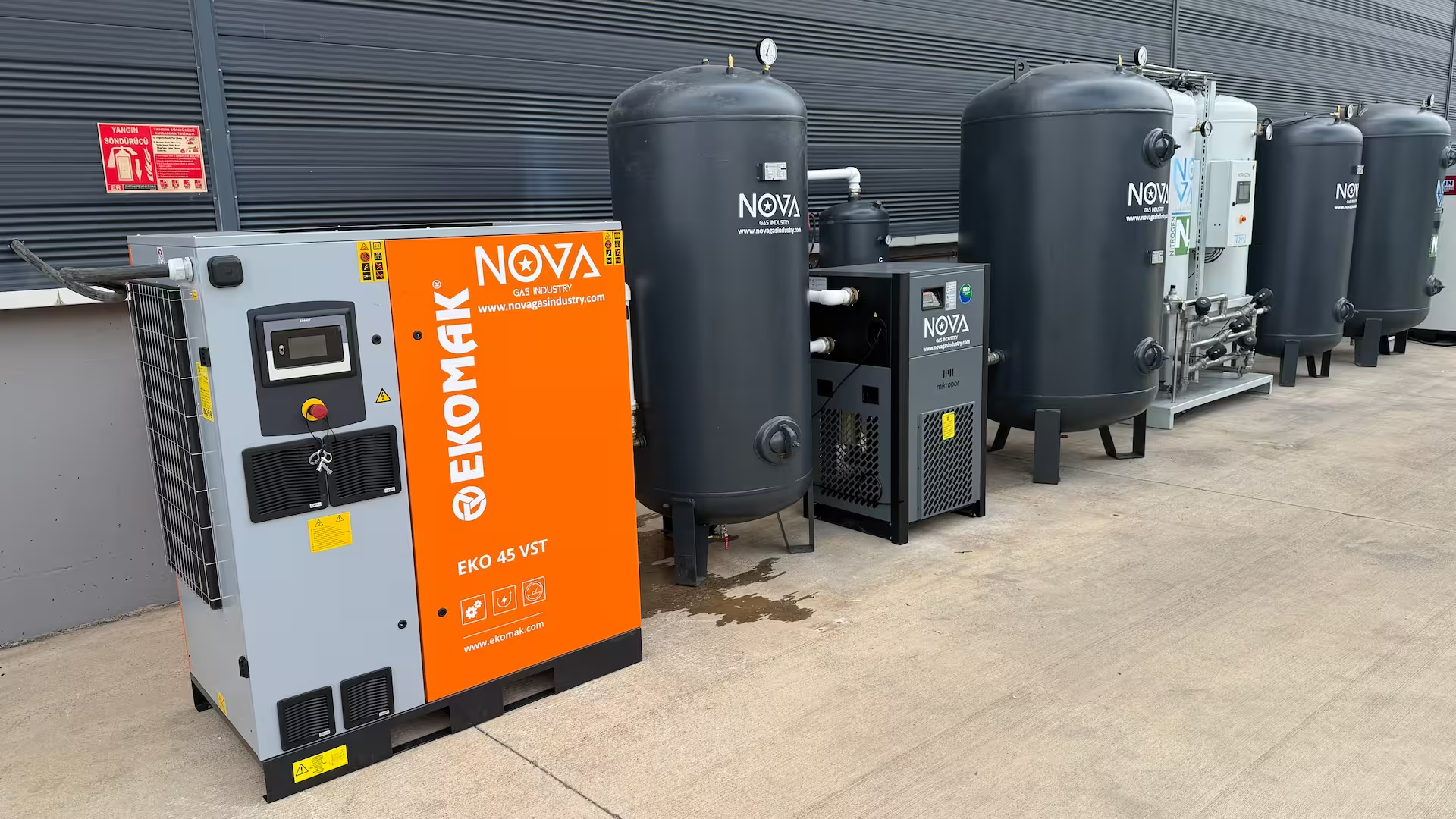
What You Need to Know Before Investing in a Nitrogen Generation System
Gas supply for industrial enterprises is a critical issue that directly affects production continuity. Relying on external supply, especially in facilities with regular and high Nitrogen Gas consumption, can create cost volatility and operational risks. Therefore, investing in a Nitrogen Generation System becomes a strategic decision for many businesses.
The on-site production model with a Nitrogen Generator offers businesses the opportunity to generate their own gas. When correctly analyzed, this approach can provide significant advantages in terms of cost control, supply security, production planning, and quality continuity.
In this article, you can examine in detail:
How a Nitrogen Generation System investment should be evaluated
Which data are important in selecting a Nitrogen Generator capacity
The impact of high-purity Nitrogen Gas needs on investment decisions
The correct planning steps for a Laser Cutting Nitrogen Generator and an Air Laser Cutting System
Why Should the Investment Decision Start with a Consumption Analysis?
The first study that needs to be done before purchasing a Nitrogen Generation System is a real consumption analysis. It is difficult to make the right capacity choice without clearly determining the hourly, daily, and monthly Nitrogen Gas needs of the enterprise. If this analysis is not conducted, the system will either remain insufficient or the investment cost will increase due to unnecessarily high capacity.
Consumption analysis should cover not only current usage but also future growth plans. Factors such as new machine investments, shift increases, or product diversity can directly affect gas needs.
Data to be analyzed in the consumption analysis:
- Daily Nitrogen Gas consumption
- Maximum hourly consumption
- Number of shifts
- Peak consumption moments
- Number of machines used
- Material types
- Current gas supply costs
- Future capacity increase plans
When this data is gathered, the investment calculation becomes more realistic. Accurate consumption analysis is the foundation of Nitrogen Generator investment.
How is Nitrogen Generator Capacity Determined?
When determining the Nitrogen Generator capacity, looking only at the average consumption value is not sufficient. The flow rate required during the peak operating times of the production line is critical data for system capacity. Furthermore, as the desired high-purity Nitrogen Gas level increases, the flow rate that the same system can produce may change.
Therefore, purity, pressure, and flow rate must be evaluated together in capacity calculations. This calculation becomes even more important in applications requiring high pressure and variable consumption, such as laser cutting.
Elements to consider in determining capacity:
- Desired gas flow rate
- Purity level
- Operating pressure
- Application type
- Compressor capacity
- Tank volume
- Consumption fluctuations
- Backup requirement
Accurate determination of capacity directly affects the long-term efficiency of the system. An undersized system can disrupt production, while an oversized system may extend the investment return period.
How Does High-Purity Nitrogen Gas Requirement Affect Investment Costs?
High-purity Nitrogen Gas requirement is one of the most important parameters in Nitrogen Generation System design. Higher purity levels may be mandatory in some applications; however, not every production process requires the highest purity. Therefore, accurate determination of the purity requirement plays a critical role in terms of investment cost.
Targeting a higher purity than necessary can affect system capacity and energy consumption. On the other hand, choosing a low purity level can adversely affect production quality. The most accurate solution is to determine the actual quality standard required by the process.
Questions to be asked in the purity decision:
- How critical is oxidation in production?
- How is the product surface evaluated by the customer?
- Is any additional processing done after laser cutting?
- Is there a requirement for sensitive sectors such as food or electronics?
- Will gas purity be measured regularly?
- How does purity variation affect production quality?
The answers given to these questions ensure that the investment is made within the correct technical framework. The high-purity Nitrogen Gas goal must balance quality requirements and cost together.
Special Criteria in Laser Cutting Nitrogen Generator Investments
Selecting a Nitrogen Generator for laser cutting enterprises is more detailed than standard gas consumption calculations. This is because consumption in laser cutting varies depending on material thickness, nozzle diameter, cutting pressure, laser power, and production speed. Therefore, when investing in a Laser Cutting Nitrogen Generator, machine data must be thoroughly analyzed.
Additionally, cutting quality expectations also affect system design. For businesses that demand oxidation-free, bright, and clean edges, the high-purity Nitrogen Gas need becomes more prominent.
Points to consider in Laser Cutting Nitrogen Generator investments:
- Laser machine brand and model information
- Type of materials cut
- Material thickness range
- Nozzle diameters
- Cutting pressure values
- Daily production intensity
- Existing compressor infrastructure
- Usage plan with Air Laser Cutting System
When these criteria are accurately analyzed, the system is designed in harmony with the laser line. Thus, the enterprise can better manage both gas costs and cutting quality.
Should the Air Laser Cutting System Be Included in the Investment Calculation?
Businesses using or planning to use an Air Laser Cutting System must view the air preparation infrastructure as an important part of the investment calculation. Because high-quality cutting requires not just high-pressure air, but dry, clean, and oil-free air.
If the Nitrogen Generation System and the Air Laser Cutting System are to operate within the same facility, the capacities of the compressor and air conditioning equipment must be calculated carefully. Otherwise, performance drops may occur while both systems use the same source.
Air infrastructure items that need to be added to the investment calculation:
- Compressor capacity
- Desiccant air dryer
- Precision filters
- Active carbon towers
- Compressed air tank
- Line diameters and piping suitability
- Condensate drain system
- Periodic maintenance costs
If these items are ignored, the true cost of the investment will be miscalculated. When correctly planned, the system operates more efficiently, safely, and with a longer lifespan.
How is the Total Cost of Ownership Calculated?
Looking only at the initial purchase price in a Nitrogen Generation System investment can be misleading. Total cost of ownership covers elements such as energy consumption, maintenance expenses, spare parts, service support, equipment lifespan, and production efficiency. This approach makes the investment decision sounder.
When comparing external gas supply with the on-site production model, monthly consumption, unit gas cost, logistics expenses, and inventory management must also be taken into account. Thus, the return on investment period for the Nitrogen Generator can be seen more clearly.
Headings to be considered in total cost calculations:
- Initial investment cost
- Energy consumption
- Maintenance and service cost
- Filter and consumable expenses
- Compressor operating cost
- Gas supply cost comparison
- Production downtime risk
- System lifespan and secondhand value
This calculation allows the enterprise to make its investment decision based on data rather than intuition. When calculated correctly, a Nitrogen Generator investment is not just a cost investment, but a production security investment.
Frequently Asked Questions – F.A.Q
1. For whom is a Nitrogen Generation System investment suitable?
It is suitable for industrial enterprises with regular Nitrogen Gas consumption. It can be evaluated especially in laser cutting, food, chemistry, electronics, and metal processing sectors.
2. Where should one start with a Nitrogen Generator investment?
The first step is a real consumption analysis. A correct system selection cannot be made without determining hourly, daily, and monthly gas needs.
3. How is the required Nitrogen Gas purity calculated?
Purity requirement is determined by the sensitivity of the production process. Oxidation, product surface, industry standards, and customer expectations influence this decision.
4. What is the most important criterion in a Laser Cutting Nitrogen Generator investment?
The actual gas consumption values of the laser machine are one of the most important criteria. Material thickness, pressure requirements, and shift intensity must also be included in the calculation.
5. Does the Air Laser Cutting System affect investment costs?
Yes, because quality air requires compressors, dryers, filters, and oil removal equipment. These equipment must be included in the total investment calculation.
6. Should Nitrogen Gas be purchased externally or produced on-site?
This decision should be made by analyzing consumption volume, cost, supply security, and production continuity. On-site production can be more advantageous for regular and high consumption.
7. What happens if the Nitrogen Generator capacity is selected too large?
An unnecessarily large capacity can increase the initial investment cost and extend the return period. Therefore, capacity should be determined according to actual needs.
8. What happens if the capacity is selected too low?
The system may become insufficient during periods of intense production. This situation can lead to pressure drops, quality problems, and production disruptions.
9. Is a compressor mandatory for a Nitrogen Generation System?
Most systems operate with a compressed air infrastructure. Therefore, a compressor infrastructure that provides appropriate capacity and high-quality air is important.
10. Does high-purity Nitrogen Gas production affect energy consumption?
Yes, the purity level can affect system performance and energy needs. Therefore, targeting unnecessarily high purity should be avoided.
11. Can a Laser Cutting Nitrogen Generator be used with any laser machine?
Solutions compatible with many machines can be planned. However, technical connection, pressure, flow rate, and consumption values must absolutely be checked.
12. Is a buffer tank necessary for Nitrogen Gas?
A buffer tank may be preferred to balance consumption fluctuations and ensure pressure stability. Tank volume should be determined based on system capacity.
13. Why is filtration important for an Air Laser Cutting System?
Air containing oil, moisture, and particles can adversely affect cutting quality and optical equipment. Therefore, a filtration system is a critical investment.
14. How is the return period for a Nitrogen Generator calculated?
Current gas costs, consumption volume, energy expenses, maintenance costs, and investment value are evaluated together. This calculation should be custom-tailored to the business.
15. Are there maintenance costs for a Nitrogen Generation System?
Yes, there are maintenance expenses such as filters, consumables, and periodic servicing. These costs should be included in the investment calculation.
16. How is the quality control of high-purity Nitrogen Gas performed?
Gas purity can be monitored with appropriate analysis devices and system controls. Regular monitoring helps maintain production quality.
17. What should the installation area for a Nitrogen Generator be like?
The area must be suitable for maintenance access, ventilation, safe placement, and equipment connections. A pre-installation site survey is therefore important.
18. Can an Air Laser Cutting System and a Nitrogen Generator use the same compressor?
It can be technically possible, but capacity calculation must be done carefully. The simultaneous consumption of the two systems is decisive in compressor selection.
19. Can the system be expanded if Nitrogen Gas consumption increases over time?
This situation depends on the system design. If future growth plans are considered during the investment phase, expansion can be much easier.
20. How to make the most accurate Nitrogen Generation System investment?
Real consumption analysis, technical survey, purity needs, total cost calculation, and service support should be evaluated together. Thus, the investment becomes suitable for both current and future production targets.