
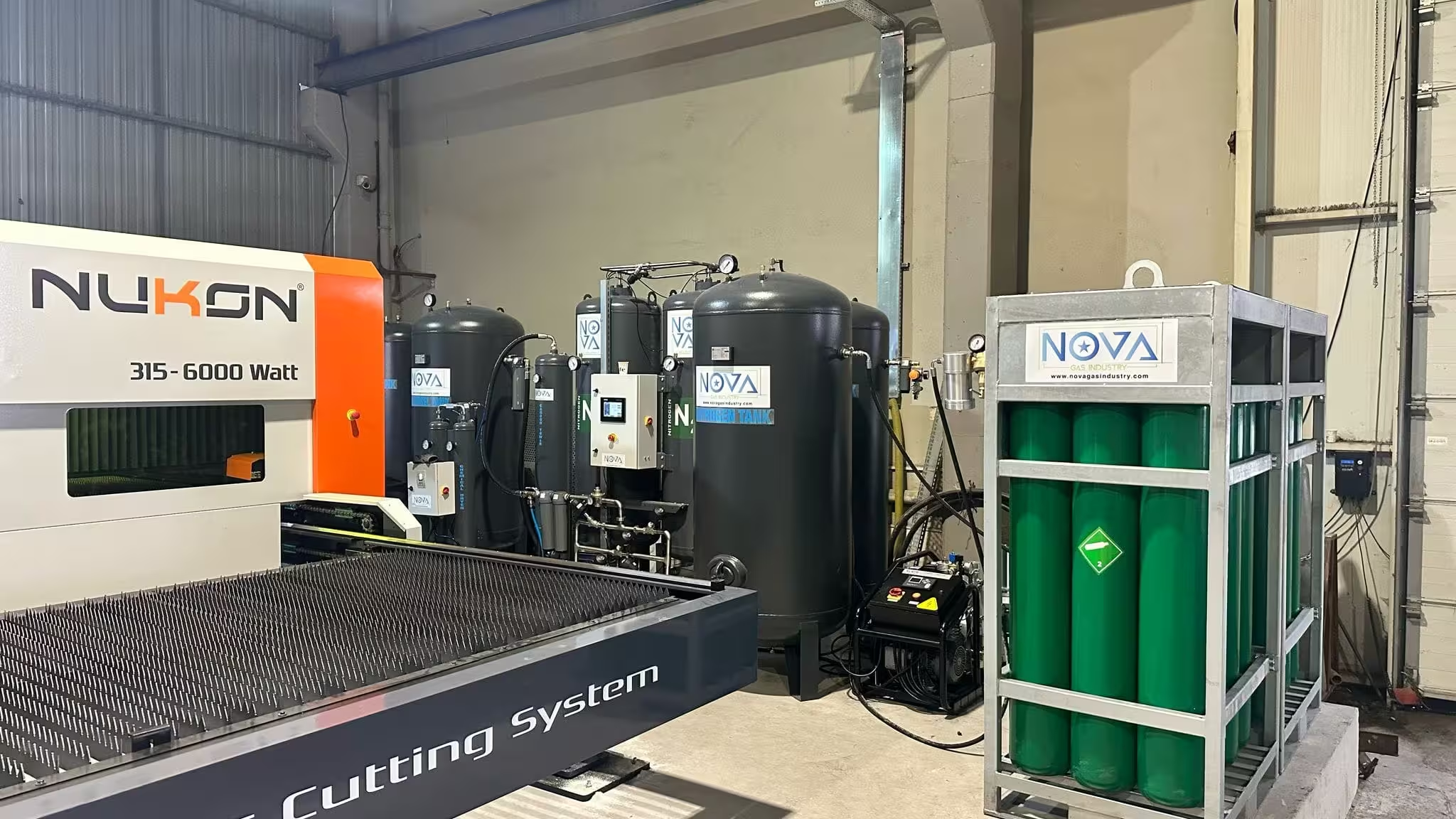
Air Laser Cutting System and the Importance of Clean Air Infrastructure
To achieve high performance in laser cutting machines, laser power or machine technology alone is not sufficient. The quality of the assist gas or air used during cutting also directly affects the results. When supported by the right air preparation infrastructure, an Air Laser Cutting System can offer businesses an efficient and flexible cutting approach.
However, the quality of compressed air is of critical importance in these systems. Air containing moisture, oil vapor, and particles can both reduce cutting quality and pose risks to laser optical equipment. Therefore, when planning an Air Laser Cutting System, air drying, filtration, and oil removal solutions must be handled professionally.
In this content, you can examine in detail:
The operating logic of the Air Laser Cutting System
The impact of clean and dry air on laser cutting
Usage scenarios together with a Nitrogen Generator and Nitrogen Gas
When the choice of a Laser Cutting Nitrogen Generator and high-purity Nitrogen Gas comes to the fore
How Does an Air Laser Cutting System Work?
An Air Laser Cutting System is based on using appropriately prepared compressed air as an assist gas. Compressed air helps remove the molten material in the cutting zone and supports the completion of the cutting process. This approach can offer a practical solution to businesses for specific materials and quality expectations.
However, it is not correct to evaluate compressed air as ordinary plant air. Air to be used in laser cutting must be specially dried, filtered, and oil-removed. Otherwise, critical components such as the cutting surface, nozzle, lens, and mirror can be adversely affected.
Air preparation requirements for an Air Laser Cutting System:
- Low moisture level
- Air purified from oil vapor
- Particle filtration
- Constant pressure value
- Sufficient flow capacity
- Regularly maintained dryer and filter system
When these requirements are met, the system operates more stably. Clean air is a fundamental necessity in laser cutting for both performance and equipment protection.
Why Does Clean Air Determine Cutting Quality?
The cutting point in laser cutting is a highly sensitive interaction zone. The quality of the air or gas used in this region can be effective on the appearance of the cut surface, dross formation, and process stability. When contaminated or moist air is used, undesirable residues, surface distortions, or optical contamination can occur during cutting.
Particularly in high-speed cutting, even small fluctuations in air quality can make a difference in the final result. Therefore, enterprises using an Air Laser Cutting System need to view the air infrastructure not as an ordinary compressor line, but as a part of production quality.
The contributions of using clean air are as follows:
- More stable cutting performance
- Protection of optical equipment
- Reduction of nozzle and lens contamination
- Prevention of moisture-related quality problems
- Maintenance needs becoming more manageable
- More predictable results in the cutting process
These advantages increase the investment value of air preparation systems. An Air Laser Cutting System without an appropriate air infrastructure may fail to deliver the expected performance.
Can a Nitrogen Generator and an Air Cutting Infrastructure Be Planned Together?
Many laser cutting enterprises may require the use of both air and Nitrogen Gas due to different materials and quality expectations. In this case, a Nitrogen Generator and an Air Laser Cutting System can be evaluated as two complementary parts of the same production strategy.
While a Nitrogen Generator is preferred for high-purity Nitrogen Gas production in jobs expecting oxidation-free and cleaner cuts, air-assisted cutting can provide a cost advantage in certain applications. The important thing here is to correctly determine which assist gas is more suitable for which job.
Points to consider when planning together:
- Gas selection according to material type
- Cutting quality expectations
- Gas and air pressure requirements
- Compressor capacity
- Air dryer and filter system
- Flow capacity of the Nitrogen Generation System
- Informing operators about the correct gas selection
Thanks to this holistic approach, the enterprise can determine the most suitable cutting strategy for each job. The right infrastructure supports flexibility and quality in laser cutting simultaneously.
When is a Laser Cutting Nitrogen Generator More Suitable?
A Laser Cutting Nitrogen Generator stands out particularly when oxidation is not desired on the cut surface and high quality is expected. Stainless steel, aluminum, and metal parts whose visual surface is important can be cited as examples of these areas of use.
While an Air Laser Cutting System may be sufficient in some applications, high-purity Nitrogen Gas can yield more suitable results in jobs where surface quality is critical. Therefore, it is a more efficient approach for businesses to make decisions based on the type of job rather than being tied to a single method.
Situations where the choice of a Laser Cutting Nitrogen Generator comes to the fore:
- Need for oxidation-free cutting
- Expectation of a bright and clean edge
- Stainless steel production
- Aluminum cutting operations
- Need for a clean surface before welding
- Repeatable quality target in mass production
In these applications, the use of Nitrogen Gas can help reduce post-cutting processes and maintain product standards. Thus, the production line operates in a more planned and efficient manner.
Nitrogen Generation System and Air Preparation Equipment
A Nitrogen Generation System should be thought of as a structure that operates depending on compressed air quality. The cleaner and drier the air entering the system, the more stable the gas production performance becomes. Therefore, auxiliary equipment such as compressors, dryers, filters, and tanks are as important as the main system.
Similarly, air quality is a determining factor for an Air Laser Cutting System. Consequently, the shared air infrastructure for both nitrogen generation and air-assisted cutting in a laser cutting enterprise must be carefully designed.
The main equipment groups are:
- Compressor
- Desiccant air dryer
- Precision filters
- Active carbon towers
- Compressed air tanks
- Nitrogen Generator
- Nitrogen storage or buffer tank
- Pressure control equipment
The correct selection of these equipment ensures not just the operation of the system, but its efficient operation. Incomplete or insufficient air preparation infrastructure can affect both Nitrogen Gas quality and laser cutting performance.
Efficiency Tips for Enterprises
In enterprises using an Air Laser Cutting System and a Nitrogen Generator, efficiency is not achieved merely by installing the devices. Operator training, regular maintenance, consumption tracking, and correct parameter management also directly affect the results.
Gas and air costs can occupy a significant place among production expenses. Therefore, enterprises need to track which gas they use in which job, reduce unnecessary consumption, and regularly check the equipment.
Recommendations for efficient use:
- Select the correct assist gas according to the material to be cut
- Do not use air and gas pressure higher than necessary
- Do not neglect filter and dryer maintenance
- Evaluate high-purity Nitrogen Gas needs on a job basis
- Regularly check compressor capacity
- Track the cleanliness of nozzles and optical parts
- Regularly analyze consumption data
These practices help both control costs and maintain cutting quality. Efficiency in laser cutting depends on correct usage habits as much as the right system.
Frequently Asked Questions – F.A.Q
1. What is an Air Laser Cutting System?
An Air Laser Cutting System is a laser cutting approach that uses appropriately prepared compressed air as an assist gas. Air quality is of critical importance for cutting performance in this system.
2. Why is dry air required in air cutting?
Moist air can adversely affect cutting quality and increase the risk of contamination in equipment. Therefore, an air drying system is one of the fundamental needs for an Air Laser Cutting System.
3. Can a Nitrogen Generator be used together with air cutting?
Yes, both a Nitrogen Generator and an Air Laser Cutting System can be used in the same enterprise. Which method to choose is determined according to material and quality expectations.
4. In which jobs is a Laser Cutting Nitrogen Generator advantageous?
It provides advantages in jobs where an oxidation-free, clean, and bright cutting surface is desired. It can be preferred especially in stainless steel and aluminum cuttings.
5. What is the fundamental difference between Nitrogen Gas and air?
Nitrogen Gas is an inert assist gas that reduces oxidation. Compressed air, on the other hand, contains oxygen and may yield different cutting results in some applications.
6. Is high-purity Nitrogen Gas necessary in every laser cutting?
It is not necessary in every laser cutting. The high-purity Nitrogen Gas need is determined based on material type, surface expectations, and customer quality standards.
7. Does an Air Laser Cutting System provide a cost advantage?
In suitable applications, the use of air can provide a cost advantage. However, it should be evaluated together with post-cutting quality and labor costs.
8. Is air quality important for a Nitrogen Generation System?
Yes, a Nitrogen Generation System requires clean and dry compressed air to operate efficiently. If air quality is low, system performance can be affected.
9. Why is oil vapor harmful in air cutting?
Oil vapor can contaminate laser optics and reduce cutting quality. Therefore, filters and towers providing oil removal are important equipment.
10. Can high-purity Nitrogen Gas be produced with a Nitrogen Generator?
Yes, a correctly configured Nitrogen Generator can produce Nitrogen Gas at a purity suitable for the needs of the enterprise. The purity level is determined according to system design.
11. Is a compressor sufficient for an Air Laser Cutting System?
A compressor alone is not sufficient. Drying, filtering, and removing oil from the air are also required.
12. Does a Laser Cutting Nitrogen Generator meet pressure requirements?
A system that is correctly selected and supported with appropriate auxiliary equipment can be planned to meet the required pressure needs. Therefore, technical calculation is important.
13. Does the use of Nitrogen Gas reduce post-processing?
With the correct materials and parameters, Nitrogen Gas can provide a cleaner cutting surface, reducing the need for post-processing. This situation can positively affect production time.
14. Is air cutting suitable for every material?
It may not be suitable for every material and quality expectation. Material thickness, surface expectations, and customer standards should be considered in the decision process.
15. How is a Nitrogen Generation System installation planned?
First, consumption, pressure, purity, and existing air infrastructure are analyzed. Then, the generator and auxiliary equipment are selected accordingly.
16. Does an Air Laser Cutting System affect optical equipment?
Contaminated or moist air can create negative effects on optical equipment. The use of clean and oil-free air reduces this risk.
17. Does a Nitrogen Generator require maintenance?
Yes, regular maintenance is required for system performance and gas quality. Filters, air preparation equipment, and control systems must be inspected at specific intervals.
18. Why is high-purity Nitrogen Gas pressure important?
Having the gas at sufficient pressure during cutting helps remove molten material. Pressure fluctuations can create inconsistency in cutting quality.
19. How are air cutting and nitrogen cutting managed together?
They can be managed by creating gas usage recipes based on job types. It is important for operators to know which gas to use with which material.
20. How to install the most efficient laser cutting infrastructure?
Machine consumption, material diversity, air quality, Nitrogen Gas requirements, and the maintenance plan should be evaluated together. The most accurate solution is created through a holistic engineering approach.